
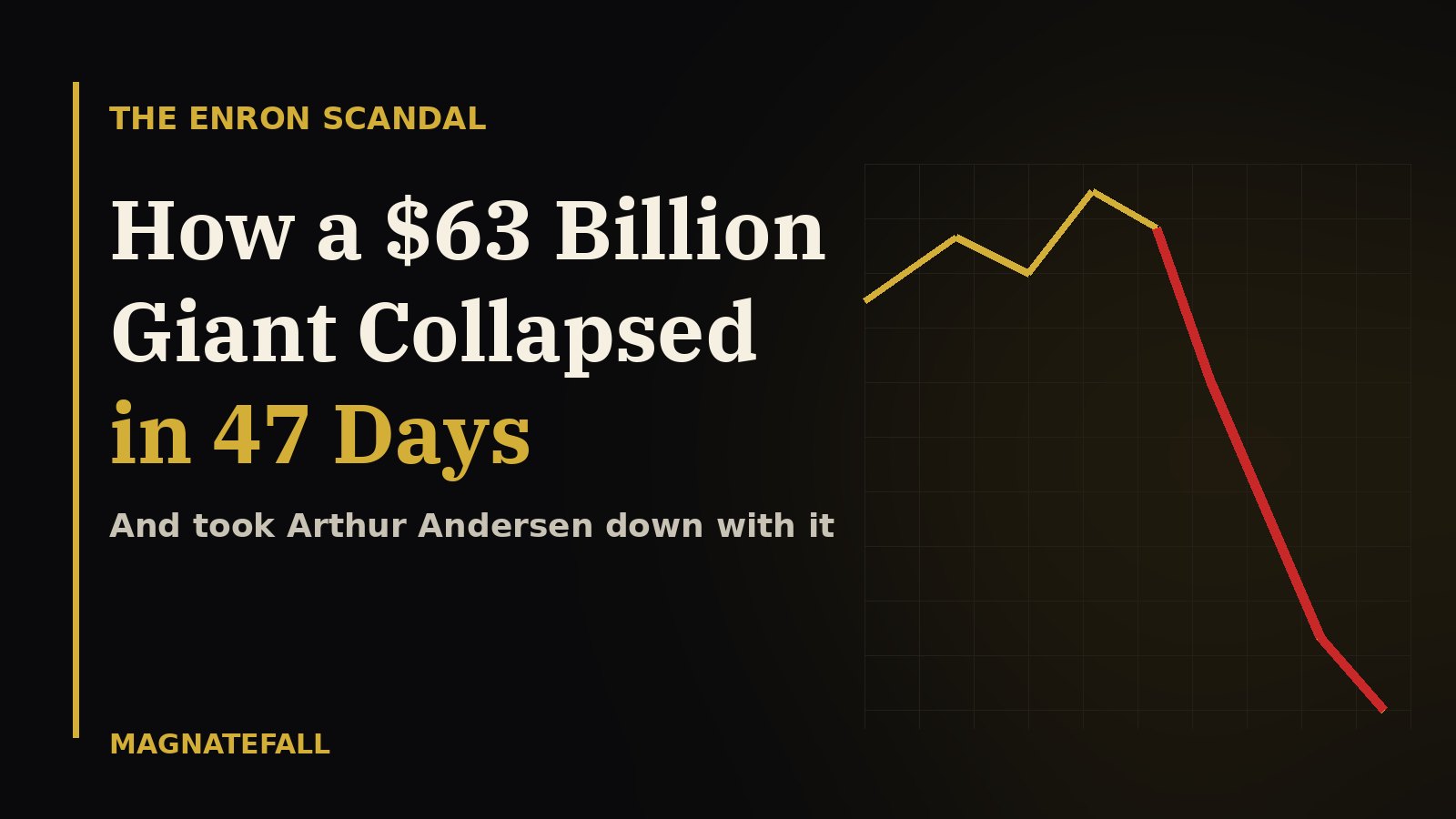
The Enron scandal is the story of an energy giant that looked like the smartest company in America and turned out to be built on hidden debt and bent accounting. Enron filed for bankruptcy on December 2, 2001, with $63.4 billion in assets, the biggest US corporate failure up to that time. Its stock fell from $90.75 to $0.26, and it took its auditor, Arthur Andersen, down with it.
The end came fast. Only 47 days passed between Enron’s first big loss announcement on October 16, 2001, and its bankruptcy filing. Here is what happened, who was responsible, and what became of them.
Key facts
- Company: Enron Corp., Houston, Texas, formed in 1985 by Kenneth Lay
- Assets at bankruptcy: $63.4 billion, filed December 2, 2001
- Stock price: $90.75 peak (August 2000) to $0.26 (November 30, 2001)
- Final countdown: 47 days from the October 16, 2001 loss report to bankruptcy
- Key people: Founder Kenneth Lay, CEO Jeffrey Skilling, CFO Andrew Fastow
- Hidden debt tools: Mark-to-market accounting and Fastow’s Chewco, LJM and Raptor entities
- Whistleblower: Sherron Watkins, letter to Lay in August 2001
- Auditor: Arthur Andersen, convicted June 2002, about 85,000 jobs worldwide affected
- Law it produced: Sarbanes-Oxley Act, signed July 30, 2002
What Was the Enron Scandal?
The Enron scandal was an accounting fraud that hid billions of dollars of debt and losses from investors. Executives used mark-to-market accounting to book profits years early and parked bad assets in partnerships run by the company’s own finance chief. When the truth came out in late 2001, Enron collapsed within weeks.
Enron started as a pipeline company. In 1985 Kenneth Lay merged Houston Natural Gas with InterNorth, and the new firm took the name Enron. By 2000 it employed about 21,000 people, reported revenue of $111 billion and ranked seventh on the Fortune 500, according to History.com. Wall Street loved it.
The trouble, as the Enron scandal would show, was that much of that growth existed only on paper.
Enron Scandal Explained: How the Fraud Worked
Mark-to-market accounting
Most companies record profit when they earn it. Enron switched to mark-to-market accounting in 1992, Investopedia notes. That let it book the full estimated value of a long-term deal on the day it was signed. If a 20-year energy contract was expected to make money, Enron could report much of that profit right away.
Mark to market accounting is legal and common for things that trade every day, like stocks. Enron used it for deals with no real market price, so managers could pick numbers that hit Wall Street’s targets. When a deal later lost money, the profit had already been counted.
Chewco, LJM and the Raptors
To keep losses and debt off its books, chief financial officer Andrew Fastow created special purpose entities. Chewco was set up in 1997 to buy out a partner in an Enron venture called JEDI, which kept JEDI’s losses off Enron’s balance sheet. In 1999 Fastow formed two partnerships, LJM1 and LJM2, named after his wife and two sons. They bought Enron’s weak assets so the company’s results looked better, according to the US Senate Permanent Subcommittee on Investigations.
Then came the Raptors, four entities named after the dinosaurs in Jurassic Park. Enron moved more than $1.2 billion in assets into them, including its own shares. In plain terms, Enron was using its own stock to insure its own investments. That only worked while the stock kept rising.
Fastow did very well from the arrangement. Enron’s own board investigation, the Powers Report of February 2002, found that he had received more than $30 million from the LJM partnerships, according to the report.
| Entity | Created | What it did |
|---|---|---|
| Chewco | 1997 | Bought a partner’s stake in JEDI so its losses stayed off Enron’s books |
| LJM1 and LJM2 | 1999 | Bought Enron’s poorly performing assets and stakes to flatter results |
| Raptors I to IV | 2000 | Used Enron’s own stock to hedge losses on its investments |
Sherron Watkins’ Warning Letter
In August 2001, Enron vice president Sherron Watkins sent Kenneth Lay an anonymous letter. “I am incredibly nervous that we will implode in a wave of accounting scandals,” she wrote. On August 22 she met Lay and handed him a longer letter explaining the problems, according to her later testimony to Congress, as reported by PBS NewsHour.
Lay asked the company’s own law firm, Vinson & Elkins, to review her concerns, even though Watkins warned that it had a conflict. The review changed little. Time magazine later named Watkins one of its three Persons of the Year for 2002, alongside two other whistleblowers.
Enron Scandal Timeline: 47 Days, Day by Day
The often-quoted figure of “47 days” is accurate when you count from Enron’s third-quarter loss report on October 16, 2001, to the bankruptcy filing on December 2. The stock’s full slide from $90.75 to $0.26 took longer, about 15 months, per History.com.
| Date | What happened |
|---|---|
| August 14, 2001 | Jeffrey Skilling quits as CEO after six months; Lay takes back the job |
| October 16, 2001 | Enron reports a quarterly loss and cuts shareholder equity by $1.2 billion |
| October 22, 2001 | The SEC opens an inquiry; the stock is around $20 |
| October 24, 2001 | Andrew Fastow is removed as CFO |
| November 8, 2001 | Enron restates its profits back to 1997 |
| November 28, 2001 | Credit ratings cut to junk and Dynegy walks away from a rescue merger; stock closes at $0.61 |
| November 30, 2001 | Stock closes at $0.26 |
| December 2, 2001 | Enron files for Chapter 11 bankruptcy |
The restatement cut reported earnings by $613 million over four years and wiped $1.2 billion off shareholder equity, according to the record of the case. Rival Dynegy had agreed to buy Enron for $8.4 billion, but backed out on November 28. “At the end, you couldn’t give it to me,” Dynegy chairman Chuck Watson later said.
The Enron Bankruptcy and Who Lost Money
The Enron bankruptcy hit ordinary people hardest, and that is why the Enron scandal still angers people today. Employees had been encouraged to hold Enron stock in their retirement plans, and many lost almost everything. About 59,000 stockholders, including pension funds, lost nearly their entire investments, the Levin Center reports. History.com puts the damage at about 5,600 jobs gone and almost $2.1 billion in pension plans wiped out by the end of 2001.
Lawsuits over the Enron scandal clawed some of it back. Shareholders recovered $7.2 billion from a $40 billion lawsuit. Enron’s creditors were paid more than $21.8 billion between 2004 and 2012, Investopedia says. The FBI called it the most complex white-collar case in its history. Agents ran more than 1,800 interviews and seized more than $168 million in assets, according to the FBI.
Arthur Andersen and the Enron Scandal: The Auditor That Died With Enron
Arthur Andersen was one of the world’s “Big Five” accounting firms and Enron’s auditor. It was founded in Chicago in 1913. At its peak its global network had about 85,000 people in 84 member firms, CBS News reported, and roughly 28,000 in the United States. Within months of the Enron collapse it was finished as an auditor.
Why did Arthur Andersen collapse?
Arthur Andersen collapsed because it was convicted of obstruction of justice. After the SEC began asking about Enron in October 2001, Andersen staff shredded paper files and deleted Enron emails. The firm was indicted in March 2002 and found guilty on June 15, 2002. Convicted felons cannot audit public companies, so Andersen gave up its licenses on August 31, 2002, the Los Angeles Times reported.
The deeper cause was trust. Andersen earned big fees from Enron for both auditing and consulting, and it signed off on the partnerships that hid Enron’s debt. Clients feared any report with Andersen’s name on it, and they left long before the verdict.
David Duncan and Arthur Andersen
David Duncan was the Andersen partner in charge of the Enron account. He and in-house lawyer Nancy Temple were named as the managers who pushed staff to follow a document destruction policy as the SEC closed in. Duncan pleaded guilty to obstruction in 2002 and testified against his own firm. He was allowed to withdraw his plea in December 2005, after the Supreme Court ruling below, the Houston Chronicle reported. In 2008 he settled SEC charges over the Enron audits without admitting or denying them, and was barred from practicing before the SEC as an accountant, per the SEC.
Arthur Andersen LLP v. United States (2005)
In Arthur Andersen LLP v. United States, 544 U.S. 696, the Supreme Court unanimously overturned the firm’s conviction on May 31, 2005. Chief Justice William Rehnquist wrote that the jury instructions “failed to convey the requisite consciousness of wrongdoing.” The jury had been told it could convict even if Andersen honestly believed it acted lawfully, the opinion shows.
The win came three years too late. Andersen had already lost its clients and most of its staff, and prosecutors chose not to retry the case. It remains one of the clearest examples of a company killed by an indictment rather than a final verdict.
Who bought Arthur Andersen?
No single firm bought Arthur Andersen. Its businesses were sold off in pieces during 2002. KPMG Consulting agreed to pay up to $284 million for most of Andersen’s consulting arms, and Deloitte & Touche took about 2,000 US tax staff, The New York Times reported. Ernst & Young, Deloitte, KPMG and Grant Thornton absorbed offices around the world.
| Buyer | What it took |
|---|---|
| KPMG Consulting (later BearingPoint) | Bulk of Andersen’s consulting units, up to $284 million |
| Deloitte & Touche | About 2,000 US tax staff, plus Andersen UK and other overseas practices |
| Ernst & Young | Many local US offices and affiliates in Australia, New Zealand and more |
| Grant Thornton | Several US practices |
| Accenture | Already split off in 2000; the old Andersen Consulting renamed itself Accenture on January 1, 2001 |
Some former partners also started a tax firm in 2002 that is known today as Andersen Tax.
Enron Scandal Key Players: The CEO, the Founder and the CFO Today
Kenneth Lay, Enron founder
Kenneth Lay founded Enron in 1985 and served as chairman and, at two points, CEO. He grew up in Missouri and earned bachelor’s and master’s degrees in economics from the University of Missouri. In a 2004 civil complaint, the SEC alleged that his Enron stock sales in 2001 alone brought in more than $90 million, according to the SEC litigation release.
On Kenneth Lay’s net worth, the record is odd. At his 2006 trial, Lay said Enron stock had made up about 90% of his wealth and that his net worth was then negative $250,000. A jury convicted him of six counts of fraud and conspiracy on May 25, 2006.
How did Ken Lay die? He died of a heart attack caused by coronary artery disease on July 5, 2006, at his home near Aspen, Colorado. He was 64, and his sentencing was months away. Because he died before his appeal, a judge wiped out his conviction on October 17, 2006, under a legal rule called abatement.
Jeffrey Skilling, the CEO of Enron
Jeffrey Skilling was the CEO of Enron for six months, from February 12 to August 14, 2001. Before that he was president and chief operating officer, and the main force behind its trading business and mark-to-market accounting. Lay first hired him in 1990 from McKinsey & Company.
On Jeffrey Skilling’s education: he earned a bachelor’s degree from Southern Methodist University in Dallas, then an MBA from Harvard Business School in 1979, graduating as a Baker Scholar, an honor Harvard gives to roughly the top 5% of the class, according to the Houston Chronicle.
Skilling was convicted in 2006 of conspiracy, securities fraud, insider trading and making false statements. He was sentenced to 24 years and four months and fined $45 million. A 2013 deal with the Justice Department cut the sentence to 14 years. Skilling was moved to a halfway house in August 2018 and released from federal custody on February 21, 2019, after about 12 years.
Andrew Fastow, the CFO
Fastow pleaded guilty in January 2004 and became a key witness against Lay and Skilling. He was sentenced in September 2006 to six years in prison and forfeited $23.8 million. He was released in 2011.
| Person | Role | Outcome |
|---|---|---|
| Kenneth Lay | Founder, chairman | Convicted 2006; died July 5, 2006; conviction vacated |
| Jeffrey Skilling | CEO (2001) | 24 years, cut to 14; released February 21, 2019 |
| Andrew Fastow | CFO | 6 years; released 2011 |
| Sherron Watkins | Vice president | Whistleblower; Time Person of the Year 2002 |
| David Duncan | Andersen lead partner | Guilty plea withdrawn 2005; SEC bar 2008 |
The Sarbanes-Oxley Act: Enron’s Legacy
The Sarbanes-Oxley Act became law on July 30, 2002, largely in response to the Enron scandal and the scandals that followed it. It raised penalties for destroying, altering or faking financial records and for defrauding shareholders. It also barred audit firms from selling many consulting services to the same companies they audit, Britannica notes.
Today chief executives and finance chiefs must personally certify their company’s financial reports. That rule exists because Lay and Skilling claimed they didn’t know what was in theirs.
Movie on the Enron Scandal: Best Documentaries to Watch
The best-known movie on the Enron scandal is Enron: The Smartest Guys in the Room (2005), directed by Alex Gibney and based on the book by Fortune reporters Bethany McLean and Peter Elkind. It was nominated for the Academy Award for Best Documentary Feature, according to the Academy of Motion Picture Arts and Sciences. McLean’s 2001 Fortune story, which asked how Enron actually made its money, was one of the first public doubts.
For a shorter corporate fraud documentary, our own Enron documentary at the top of this page walks through the 47 days in order, with the numbers on screen. If you like this kind of story, the FTX collapse shows the same pattern two decades later, run by a founder who also hid losses in a sister company.
What Happened to Enron After Bankruptcy?
Enron spent years selling off what was left. It sold its last business, Prisma Energy, in 2006 and renamed itself Enron Creditors Recovery Corp. in 2007 to wind up its affairs. John J. Ray III, who later ran the FTX bankruptcy, oversaw part of that cleanup.
Key takeaways
- Enron used mark-to-market accounting and Fastow’s partnerships to hide debt and inflate profits.
- Its stock fell from $90.75 to $0.26; 47 days separated the October 16, 2001 loss report from bankruptcy.
- Arthur Andersen was convicted of obstruction, lost its licenses and broke apart, though the Supreme Court later overturned the verdict.
- Skilling served about 12 years; Lay died before sentencing; the scandal produced the Sarbanes-Oxley Act.
The Enron scandal is the template for the frauds that came after. Bernie Madoff hid losses behind fake statements, Theranos and Elizabeth Holmes hid a failed product behind secrecy, and Sam Bankman-Fried hid a hole in customer funds inside a sister company, just as Fastow did.
Enron Scandal: FAQ
What was the Enron scandal?
An accounting fraud at Houston energy company Enron. Executives used mark-to-market accounting and off-balance-sheet partnerships to hide debt and inflate profits. Enron filed for bankruptcy on December 2, 2001, with $63.4 billion in assets.
Who was the CEO of Enron?
Jeffrey Skilling was CEO from February to August 2001. Founder Kenneth Lay was CEO before and after him. Skilling was sentenced to 24 years, later cut to 14, and was released in February 2019.
Who was the Enron founder?
Kenneth Lay. He formed Enron in 1985 by merging Houston Natural Gas with InterNorth and served as its chairman.
How did Ken Lay die?
Lay died of a heart attack caused by coronary artery disease on July 5, 2006, near Aspen, Colorado, before he could be sentenced. His conviction was vacated in October 2006.
Why did Arthur Andersen collapse?
It was convicted in June 2002 of obstruction of justice for destroying Enron documents. Convicted firms cannot audit public companies, so it surrendered its licenses, and clients and staff left. The Supreme Court overturned the conviction in 2005, too late to save it.
What was Arthur Andersen LLP v. United States?
The 2005 Supreme Court case that unanimously overturned Andersen’s obstruction conviction because the jury instructions did not require proof that the firm knew it was doing wrong.
Who bought Arthur Andersen?
No single buyer. In 2002 KPMG Consulting, Deloitte, Ernst & Young and Grant Thornton bought different practices and offices. Its old consulting arm had already become Accenture.
What was David Duncan’s role at Arthur Andersen?
He was the lead partner on the Enron audit. He pleaded guilty to obstruction in 2002, later withdrew the plea, and in 2008 settled SEC charges and was barred from practicing before the SEC.
When was Jeffrey Skilling released?
He was released from federal custody on February 21, 2019, after serving about 12 years. He had moved to a halfway house in August 2018.
What is the best movie on the Enron scandal?
Enron: The Smartest Guys in the Room (2005), directed by Alex Gibney, was nominated for an Oscar. Our free Enron documentary is embedded at the top of this page.
The Verdict
The Enron scandal wasn’t about energy trading being a bad business. It fell because its leaders chose to report the company they wanted instead of the one they had, and an auditor that should have said no kept saying yes. When the numbers finally met reality, a $63 billion company and an 89-year-old accounting firm were gone within a year.
Sources and further reading
- History.com: Enron files for bankruptcy, December 2, 2001
- Investopedia: Enron scandal and accounting fraud
- Levin Center: Congress and the Enron scandal
- FBI: Enron case history
- Britannica: Enron scandal
- CBS News: Andersen sells units (2002)
- The New York Times: Andersen makes 3 deals to sell parts of firm (May 9, 2002)
- Los Angeles Times: Andersen says goodbye to accounting (Aug 31, 2002)
- Justia: Arthur Andersen LLP v. United States, 544 U.S. 696 (2005)
- SEC: David B. Duncan litigation release (2008)
- Houston Chronicle: Feds won’t retry Andersen
- US Senate Permanent Subcommittee on Investigations: The Role of the Board of Directors in Enron’s Collapse (2002)
- Powers Report: Report of the Special Investigative Committee of the Board of Directors of Enron Corp. (February 1, 2002)
- US Senate Commerce Committee hearing: Collapse of the Enron Corporation, with testimony by Sherron Watkins and Jeffrey Skilling (February 26, 2002)
- PBS NewsHour: Enron whistle-blower testifies (February 14, 2002)
- The New York Times: Text of Sherron Watkins’ letter to Kenneth Lay (January 16, 2002)
- SEC: Litigation release against Richard Causey, Jeffrey Skilling and Kenneth Lay
- US Department of Justice: Andrew Fastow guilty plea (January 14, 2004)
- US Department of Justice: Jeffrey Skilling resentenced to 168 months (June 21, 2013)
- Houston Chronicle: Jeffrey K. Skilling timeline
- Academy of Motion Picture Arts and Sciences: 78th Academy Awards nominees (2006)
By Magnatefall Team. Facts are checked against court records, regulator filings and company reports. Spotted an error? Send a correction.
Watch the full file: how $63 billion vanished in 47 days. Watch our documentary for the full Enron file, from the Watkins letter to the bankruptcy filing and the fall of Arthur Andersen. Free on YouTube, with two new documentaries every day.
More files:
- The FTX Collapse Explained: How $32 Billion Vanished in Seven Days
- Bernie Madoff’s Ponzi Scheme: How the Biggest Fraud in History Stole $65 Billion
- Sam Bankman-Fried: How the $32 Billion Crypto King Was Convicted and Sentenced to 25 Years
- Browse more in Billion-Dollar Scams documentaries
- Browse more in Mogulgrave documentaries
- See every Magnatefall documentary file
Ask AI about this file
Prefer to watch? See this story on YouTube or subscribe to Magnatefall.
More files you should read
 Billion-Dollar ScamsBuilder.ai: The $1.5 Billion AI That Was Human
 Billion-Dollar ScamsThe FTX Collapse Explained: How $32 Billion Vanished in 7 Days
 Billion-Dollar ScamsSam Bankman-Fried: How He Faked $32 Billion (and Lost It All)
 Billion-Dollar ScamsWhere Is Elizabeth Holmes Now? How She Lost $4.5 Billion (And Got 11 Years)