
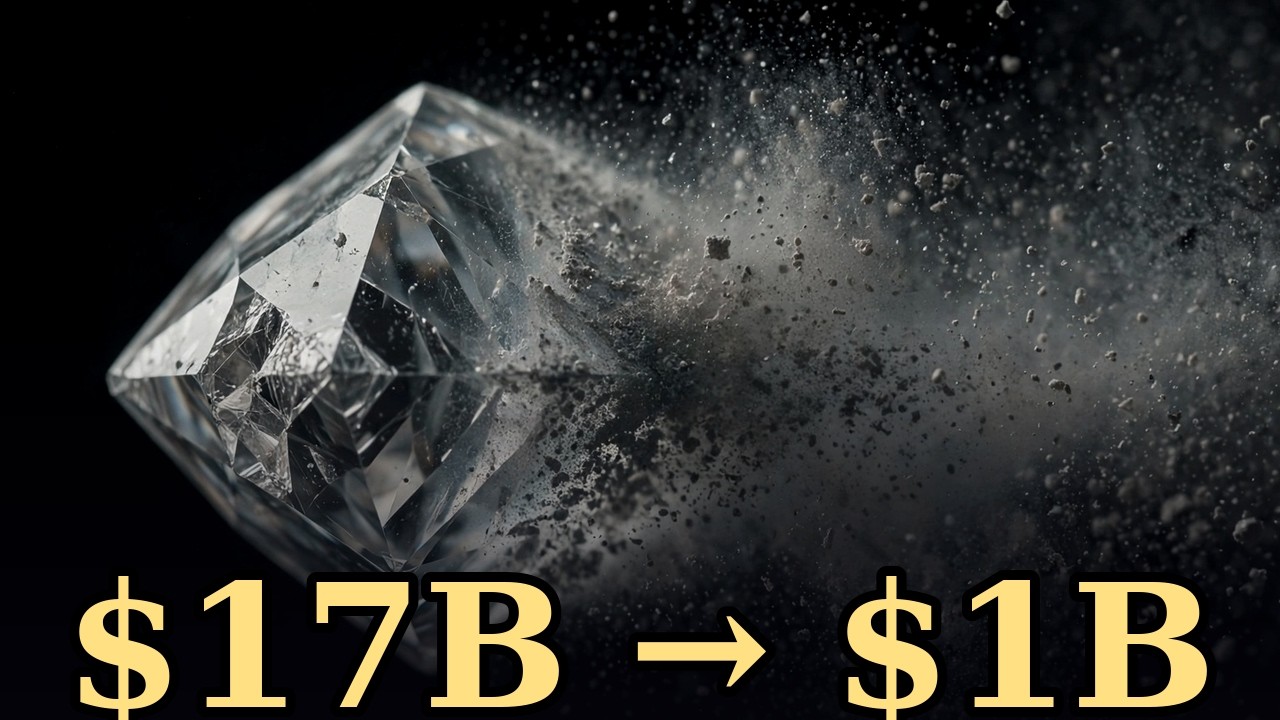
Lab-grown diamonds vs natural diamonds comes down to this: they are the same material, but not the same market. A lab-grown diamond is real diamond, with the same chemistry and sparkle. It now costs a small fraction of a mined stone. That price gap helped break the most famous monopoly in luxury goods.
De Beers was taken private in 2001 in a deal that valued it at about $17.6 billion. In 2026, its owner, Anglo American, has been in talks to sell it for about $1 billion, Bloomberg reported. Here is what lab-grown diamonds are, what they cost, whether they hold value, and how they helped erase more than $16 billion from De Beers.
Key facts
- Founded: 1888, by Cecil Rhodes in Kimberley, South Africa
- 2001: taken private by Anglo American and the Oppenheimer family in a deal valued at about $17.6 billion
- 2018: De Beers launches Lightbox lab-grown jewelry at $800 per carat; the U.S. FTC drops “natural” from its definition of a diamond
- May 8, 2025: De Beers announces it will close Lightbox, saying lab-grown wholesale prices fell about 90% since 2018
- 2023-2025: Anglo American writes down De Beers by a total of about $6.8 billion
- February 2026: De Beers’ carrying value cut to $2.3 billion
- 2026 sale: talks value De Beers at about $1 billion, per Bloomberg; Botswana owns 15%
Prefer to watch? See the full documentary, how De Beers lost more than $16 billion. Free on YouTube.
What Are Lab-Grown Diamonds?
A lab-grown diamond is a diamond made by people instead of by the Earth. It is pure carbon arranged in the same crystal structure as a mined diamond. It isn’t a coating, a glass copy or a cubic zirconia. It is the same substance, grown in weeks instead of over billions of years.
There are two main methods. HPHT, short for high pressure, high temperature, recreates the crushing heat and pressure deep underground inside a press. CVD, or chemical vapor deposition, grows a diamond layer by layer from carbon-rich gas inside a vacuum chamber. Both produce rough crystals that are then cut and polished exactly like mined stones.
India and China are now the largest producers, and the output has grown enormously. Analyst Paul Zimnisky has estimated that lab-grown stones make up around a third of the global diamond jewelry market.
Are Lab-Grown Diamonds Real?
Yes. In 2018, the U.S. Federal Trade Commission updated its Jewelry Guides and removed the word “natural” from its definition of a diamond. Under those guides, a lab-grown diamond is a diamond. But sellers must say clearly that it was made in a lab, with terms such as “laboratory-grown” or “laboratory-created.”
Major gem labs, including the Gemological Institute of America, grade lab-grown diamonds. Many lab-grown stones also carry a tiny laser inscription on the girdle identifying them as grown.
What lab-grown diamonds are not is rare. That is the whole debate in one word. A natural diamond’s value has always rested on scarcity and a story. A lab diamond’s value rests on the cost of making it, and that cost keeps falling.
Can a jeweler tell them apart? Not by looking. Under a normal loupe, a well-cut lab-grown stone and a mined one look the same. Gem labs use spectroscopy and other specialized instruments that read tiny differences in growth patterns and trace elements. That is why a grading report from a recognized lab matters so much. Whichever stone you buy, ask for one.
Lab-Created Diamonds vs Real Diamonds: The Differences That Matter
“Lab-created” and “real” are not opposites, even though people often search for them that way. The useful comparison is lab-grown versus mined. Here is how they line up.
| Feature | Lab-grown diamond | Natural diamond |
|---|---|---|
| Chemical makeup | Pure carbon, diamond crystal structure | Pure carbon, diamond crystal structure |
| Appearance | Same sparkle and hardness; looks identical to the naked eye | Same sparkle and hardness; looks identical to the naked eye |
| Origin | Grown in weeks by HPHT or CVD | Formed underground over billions of years and mined |
| Price per carat (1 ct, early 2025 estimate) | About $845 | About $3,895 |
| Resale value | Very limited; often little to no secondary market | Below retail, but an established resale market exists |
| Environmental cost | Depends heavily on the energy used to grow it | Depends on the mine; involves moving large amounts of earth |
| Disclosure | Must be disclosed as lab-grown in the U.S. | Sold as natural or mined |
The price figures above are estimates from analyst Paul Zimnisky for a generic one-carat round stone, as reported in March 2025. Retail prices vary widely by quality and seller.
Lab-Grown Diamonds vs Moissanite vs Cubic Zirconia
A lab-grown diamond is a real diamond. Moissanite and cubic zirconia are not. They are simulants that only look like diamonds, and they are made of different materials with different hardness, GIA explains. That is why they cost so much less.
| Stone | What it is | Mohs hardness | How it looks |
|---|---|---|---|
| Natural diamond | Carbon, formed underground | 10 | Benchmark brilliance |
| Lab-grown diamond | Carbon, same crystal structure | 10 | Same as natural |
| Moissanite | Silicon carbide | 9.25 | More than twice the fire; doubled back facets |
| Cubic zirconia | Zirconium dioxide | 8 to 8.5 | More colorful flashes, less brilliance; can yellow over time |
Cubic zirconia often costs less than 5% of a comparable diamond, GIA notes. Lab-grown diamonds sit between simulants and mined stones on price.
Cost of Lab-Grown Diamonds
The cost of lab-grown diamonds has fallen faster than almost anyone predicted. When De Beers launched its Lightbox brand in 2018, it priced lab-grown stones at $800 per carat. At the time, that was considered aggressively cheap.
Seven years later, De Beers said wholesale prices for lab-grown jewelry had dropped about 90% since that launch. Industry analyst Edahn Golan reported in 2026 that his lab-grown wholesale price index was down about 96% since he began tracking it in 2018.
Retail prices have fallen too, though not as much, because many jewelers kept wide margins. Zimnisky’s early-2025 estimate put a one-carat lab-grown stone at about $845 per carat, against about $3,895 for a comparable natural stone. In other words, the lab-grown version cost roughly a fifth as much, and the gap gets wider as stones get bigger.
How Much Are Lab-Grown Diamonds Worth?
Usually far less than you paid. Wholesale prices for lab-grown stones are down about 90% to 96% since 2018, according to the figures below, and that drags down resale value. This is where buyers need to be honest with themselves. What you pay for a lab-grown diamond and what it’s worth after you buy it are two very different numbers.
Because producers can keep making more, and because production costs keep falling, lab-grown diamonds have very weak resale value. Many jewelers won’t buy them back at all, and those that do typically offer a small fraction of the original price. If you want a beautiful stone for less money, that may not matter. If you think of a diamond as something that stores value, it matters a lot.
Natural diamonds don’t hold value perfectly either. Resale prices usually come in well below retail. But there is an established secondary market for them, and that is the main financial difference between the two.
Lab-Grown Diamonds vs Natural Prices in 2026
The gap is still huge. A near-colorless, excellent-cut lab-grown diamond can cost about $450 on Brilliant Earth, while a natural stone with the same specs runs about $2,800 to $3,200, CNBC found in September 2026. Brilliant Earth says lab stones can be as much as 90% cheaper.
| Measure | Figure |
|---|---|
| Average 1-carat natural diamond, 2026 | $3,898 (Rapaport data) |
| Same measure in 2021 | $8,007 |
| Drop in five years | 51% |
| Similar lab-grown stone at Brilliant Earth | About $450 |
| Engagement rings with a lab-grown center stone, 2025 | 61%, up 239% since 2020 (The Knot) |
| Diamond Standard Index low, early August 2026 | 2,490, its lowest ever |
Natural stones are falling too. Mines overproduced during Covid, and stock built up in 2023 and 2024. De Beers said in July 2026 that it would halt its Venetia mine in South Africa for more than two years to cut supply. Diamond Standard CEO Cormac Kinney told CNBC he sees the beginning of a recovery for some qualities.
If you’re buying a ring to keep, the lab stone gives you more diamond for the money. If you care about resale, be careful with both. A diamond can sit for over a year on the secondary market, and stones often sell for less than half their retail price, CNBC reported. “You shouldn’t be buying a diamond thinking that there’s a financial investment [aspect] to it,” one New York jeweler said.
Diamond Prices Over Time
For most of the 20th century, diamond prices moved in one direction: up, and smoothly. That was not an accident. De Beers controlled most of the world’s rough diamond supply and held stones back when demand weakened, keeping prices steady.
That system weakened in the 2000s. De Beers moved away from stockpiling, and its share of global supply shrank as new mines opened elsewhere. Then lab-grown stones arrived at scale. Natural diamond prices have fallen sharply since 2022. Demand from China slumped, and shoppers switched to lab-grown stones for engagement rings and fashion jewelry. In the first nine months of 2026, De Beers’ average realized price fell 37% to $97 per carat. Part of the drop came from selling more lower-value stones.
De Beers and Lab-Grown Diamonds: Timeline
- 1888: Cecil Rhodes founds De Beers in Kimberley, South Africa.
- 2001: Anglo American and the Oppenheimer family take De Beers private at about $17.6 billion.
- 2012: Anglo pays $5.1 billion for the Oppenheimers’ 40% stake.
- 2018: The FTC drops “natural” from its definition of a diamond; De Beers launches Lightbox.
- 2023-2025: Anglo writes down De Beers by about $6.8 billion.
- May 2024: Anglo puts De Beers up for sale.
- May 8, 2025: De Beers says it will close Lightbox.
- February 2026: Carrying value cut to $2.3 billion.
- July 2026: A group led by Gareth Penny is named preferred bidder.
The De Beers Monopoly — and How It Broke
Cecil Rhodes founded De Beers in 1888 in Kimberley, South Africa. The Oppenheimer family later built it into a company that controlled most of the world’s rough diamond trade for much of the 20th century. It decided how many stones reached the market and at what price.
It also shaped how people felt about diamonds. The slogan “A Diamond Is Forever,” created for De Beers by the agency N. W. Ayer in 1947, helped make a diamond engagement ring feel essential in the United States and later around the world.
In 2001, Anglo American and the Oppenheimer family took De Beers private in a deal valued at about $17.6 billion. In 2012, Anglo paid $5.1 billion for the Oppenheimers’ 40% stake, giving it 85% of the company. The government of Botswana owns the other 15%.
Then came the lab-grown wave. De Beers tried to fight it from both sides. It launched Lightbox in 2018 to sell lab-grown jewelry cheaply and position it as fun fashion, not a substitute for an engagement ring. Prices collapsed anyway. On May 8, 2025, De Beers said it would close Lightbox.
The financial damage showed up in Anglo’s accounts. Anglo wrote down De Beers by about $6.8 billion in total from 2023 through 2025. In February 2026 it cut the carrying value to $2.3 billion. It put the company up for sale in May 2024. In July 2026 it picked a group led by former De Beers chief executive Gareth Penny as preferred bidder. Bloomberg has reported that talks value De Beers at about $1 billion. As of October 2026, no final deal has been signed.
From about $17.6 billion in 2001 to about $1 billion in 2026 is a fall of more than $16 billion in value, before even counting inflation. Our De Beers documentary tells that story from the first mine in Kimberley to the sale.
Key takeaways
- Lab-grown diamonds are real diamonds with the same chemistry; the FTC dropped “natural” from its definition of a diamond in 2018.
- They cost a small fraction of mined stones, and their wholesale prices have fallen sharply since 2018.
- De Beers was valued at about $17.6 billion in 2001 and was for sale at about $1 billion in 2026.
- Anglo American wrote down De Beers by about $6.8 billion from 2023 to 2025.
De Beers lost its grip slowly. Other empires fell in days: Sam Bankman-Fried went from crypto king to convicted fraudster within a year, and Bernie Madoff’s empire vanished overnight when the 2008 crisis hit.
Lab-Grown Diamonds vs Natural: FAQ
Are lab-grown diamonds real diamonds?
Yes. They are pure carbon with the same crystal structure as mined diamonds. The U.S. Federal Trade Commission treats them as diamonds, as long as sellers clearly disclose that they were grown in a lab.
Why are lab-grown diamonds cheaper?
They can be made in weeks, in growing quantities, and the cost of production keeps falling. Natural diamonds are limited by what can be mined, so their prices are based on scarcity.
What happened to De Beers?
Lab-grown competition and weak demand pushed diamond prices down. Its owner, Anglo American, has written down its value by about $6.8 billion since 2023 and is in talks to sell it at a value of about $1 billion, according to Bloomberg.
Do lab-grown diamonds hold value?
Generally, no. Resale value is very limited because supply is not scarce and prices keep falling. Natural diamonds also resell below retail, but they have an established secondary market.
Can a jeweler tell the difference?
Not by eye. Lab-grown and natural diamonds look the same, even under a regular jeweler’s loupe. Telling them apart requires specialized testing equipment, which major gem labs use, and many lab-grown stones are also laser-inscribed.
Why did diamond prices fall?
Lab-grown stones flooded the market at much lower prices, and demand from China weakened sharply after 2022. Together, those trends pushed down prices for lab-grown stones and for many natural ones.
How much cheaper is a lab-grown diamond?
In one September 2026 CNBC comparison, about 85% cheaper: roughly $450 for a lab-grown stone against $2,800 to $3,200 for a natural stone with the same grades. Brilliant Earth says the gap can reach 90%.
Is a diamond a good investment?
Usually not. There is no standard spot market, stones can take more than a year to resell, and they often fetch less than half their retail price. Lab-grown stones have even weaker resale value.
How many engagement rings are lab-grown?
Most of them now. Lab-grown center stones made up 61% of engagement ring sales in 2025, according to The Knot’s 2026 Real Weddings Study.
Is a lab-grown diamond the same as moissanite?
No. A lab-grown diamond is pure carbon with the same structure as a mined diamond. Moissanite is silicon carbide, a different gem that is slightly softer and shows more rainbow fire.
Is a lab-grown diamond cubic zirconia?
No. Cubic zirconia is zirconium dioxide, a cheap simulant that scratches more easily. A lab-grown diamond has the same chemical, physical and optical properties as a natural one.
The Verdict on Lab-Grown Diamonds vs Natural
In the lab-grown diamonds vs natural diamonds debate, chemistry has already given its answer: both are diamonds. The real difference is scarcity, and scarcity is exactly what De Beers spent a century selling. Once a factory could make the same stone for a fraction of the price, that story got harder to tell. A company once worth about $17.6 billion was left looking for a buyer at about $1 billion.
If you’re shopping, choose with clear eyes. Lab-grown gives you more stone for your money. Natural gives you rarity and a resale market. Neither choice is wrong, as long as you know which one you’re paying for.
Sources and further reading
- Federal Register: FTC Guides for the Jewelry, Precious Metals, and Pewter Industries (Aug 16, 2018)
- Anglo American press releases (De Beers results and impairments)
- De Beers Group
- CNBC: What’s behind the fall of diamond prices to record lows (Sept 26, 2026)
- GIA: What are simulated diamonds?
- GIA: Diamond alternatives for engagement rings
By Magnatefall Team. Facts are checked against court records, regulator filings and company reports. Spotted an error? Send a correction.
Watch the full file: how De Beers lost more than $16 billion. Watch our documentary for the full De Beers file: the monopoly, the slogan, the lab-grown shock and the collapse in value. Free on YouTube, with a new documentary every week.
Ask AI about this file
Prefer to watch? See this story on YouTube or subscribe to Magnatefall.
More files you should read
 Billion-Dollar ScamsThe FTX Collapse Explained: How $32 Billion Vanished in Under a Week
 Billion-Dollar ScamsSam Bankman-Fried: How the $32 Billion Crypto King Was Convicted and Sentenced to 25 Years
 Billion-Dollar ScamsWhere Is Elizabeth Holmes Now? From a $4.5 Billion Fortune to a Texas Prison Cell
 Billion-Dollar ScamsElizabeth Holmes and Theranos: How a $9 Billion Blood-Testing Empire Became a Fraud